
Lords Mobile Treasure Trove: how many Gems are free to spend?
A Treasure Trove payout includes your original deposit. Use an actual game screen to separate the gain, the next deposit and the reserve for upcoming purchases.
Published
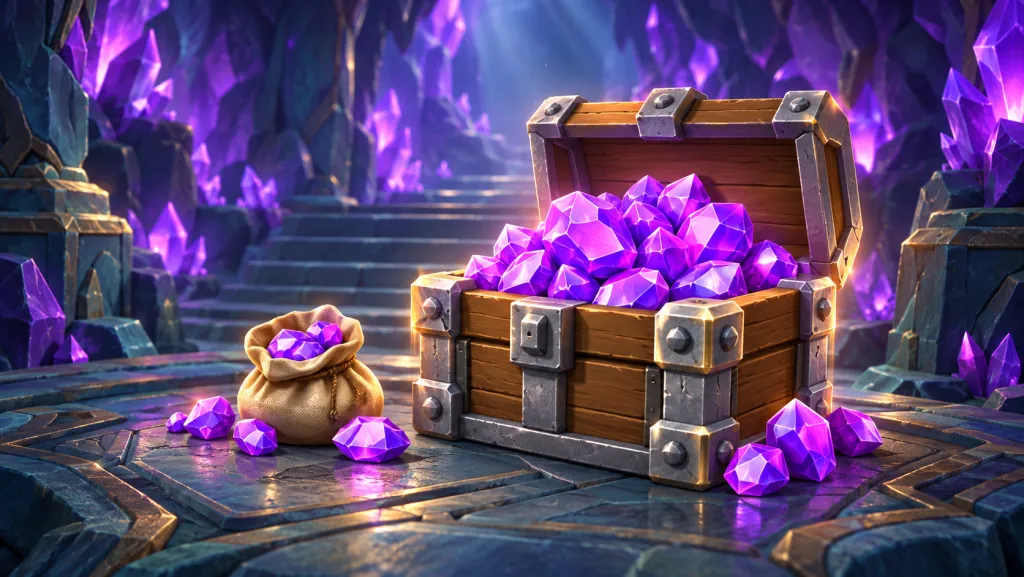
It is easy to overestimate your future Gem balance in Lords Mobile's Treasure Trove: the large payout includes the Gems you deposited yourself. IGG's historical Treasure Trove guide provides the background to this feature. If you want to repeat the same deposit, reserve that amount first, then plan purchases from what remains. Otherwise, a successful collection can leave you making a smaller deposit next time.
What the payout contains
Look at the archived game screen from a lordsmobile.org community article dated June 18, 2018. It shows a 30-day deposit, 21,350 Gems invested and a payout of 43,767. This illustrates how to read the interface rather than promising a current return: the source does not separately specify the capture date or client version. Check your own amount, duration and payout in the game.
In this example, the gain is 43,767 − 21,350 = 22,417 Gems. That is the amount above the original deposit. To invest the same 21,350 again, you must reserve that amount from the full payout. Saying you earned 43,767 incorrectly counts the returned deposit as a gain too.
There is another detail: the timer in the screenshot is still running. The displayed payout is expected at the end of the deposit period; the image does not confirm that it has been collected. Do not add that line to the Gems available for a purchase right now.
Open the original screen at full size

Use three budget amounts instead of one large total
Separate your balance into the next deposit, a reserve for upcoming needs and the freely available remainder. Keep the first amount for reinvestment, the second for planned spending and distribute the third between upgrades. This lets you compare purchases before the Gems are spent.
Here is a hypothetical example with different figures. After collecting a payout, you have 50,000 Gems in total. You choose to keep 20,000 for the next deposit and 5,000 for upcoming expenses, leaving 25,000 for other purchases. Buying 35,000 Gems' worth of items would leave you 10,000 short of the original plan, even if the game lets you complete the purchase.
The 5,000 is not a reserve recommended for everyone. Its size depends on your schedule and planned actions. Identify a specific need and the amount shown on your own screen. An uncalculated just-in-case amount is as difficult to use as a promise to spend the entire remainder.
The deposit term belongs in the budget too
Before depositing, record two dates: when the deposit ends and when you need the Gems. If a planned purchase comes first, budget for it separately. A large future payout does not solve today's shortage. Check early-cancellation terms in the current confirmation window; the full-term payout does not establish how much cancellation returns.
For each option, calculate the gain as payout minus deposit and record the duration alongside it. Dividing the gain by days gives an average comparison figure. It is not a daily credit of spendable Gems, nor a promise of automatic renewal. For repeated deposits, account separately for collection timing and whether you can invest the required amount again.
When increasing the deposit may help
IGG's April 15, 2019 guide associates Treasure Trove upgrades with higher deposit limits and an interest bonus. This is a historical description, rather than a current table of every limit. For an upgrade decision, compare the current parameters and cost on your own account.
Ask how many additional Gems the change would provide at the amount you can actually invest. Raising the ceiling does not automatically increase your deposit: you must first have the extra Gems. When comparing the cost with a future gain, include the waiting period and any Gems you will need before the payout.
After collecting the Gems, return to the three budget amounts. Check the next deposit, keep your calculated reserve and choose one near-term goal for the remainder. This makes Treasure Trove gains a clear development resource, without starting every cycle by looking for the missing deposit.