
Forged a rare item nobody buys? Understanding Doomsday's auction
Rarity does not guarantee a sale. Learn to read Squad Equipment attributes, compare listings and distinguish the Bidding Hall from ordinary offers using an original game screen.
Published · Updated
A rare Doomsday item can be a good find and a poor product at the same time. A buyer needs equipment for a particular squad; a gold border alone does not meet that need. Before forging again, it is more useful to open comparable listings and read the attributes of the item you already have.
In an August thread about obtaining Gold without purchases, one player reports equipment revenue while another cannot sell items even at the minimum price. Both accounts may be true: they describe different items and trades, rather than guaranteed forging income.
What is actually sold at the auction
This concerns Squad Equipment: firearms, tactical weapons, body armor and masks. The official version 1.49.0 description says it is made using alloys obtained from the Refinery. Each troop type has its own set, with effects applying to the corresponding type.
High-quality items can be sold for Gold, with inspection before delivery after purchase. This is separate from hero Armament and its Resonance: advice about resetting Nanocatalysts should not be applied to melting down Squad Equipment.
Rarity is obvious; usefulness takes reading
Start by asking: who would equip this item, and for what purpose? Gathering and combat squads need different advantages. A name, color and overall item power help identify it, but cannot replace reading individual attributes.
In another discussion, a player found a red item and wanted its large load bonus for moving resources. Its other attributes did not fit the plan well. Replies even had to distinguish Squad Load, carrying capacity, from Squad Size. Similar wording can change the meaning of a purchase.
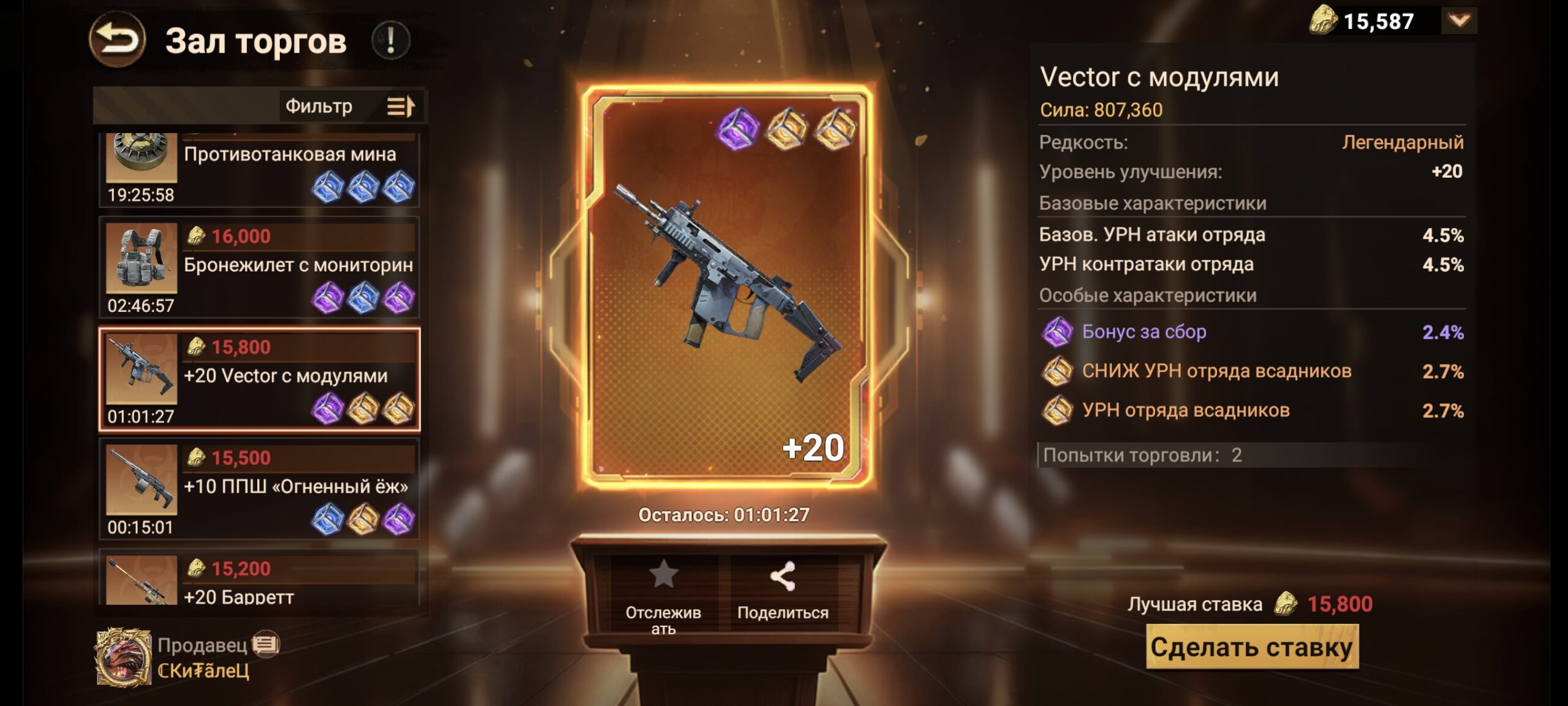
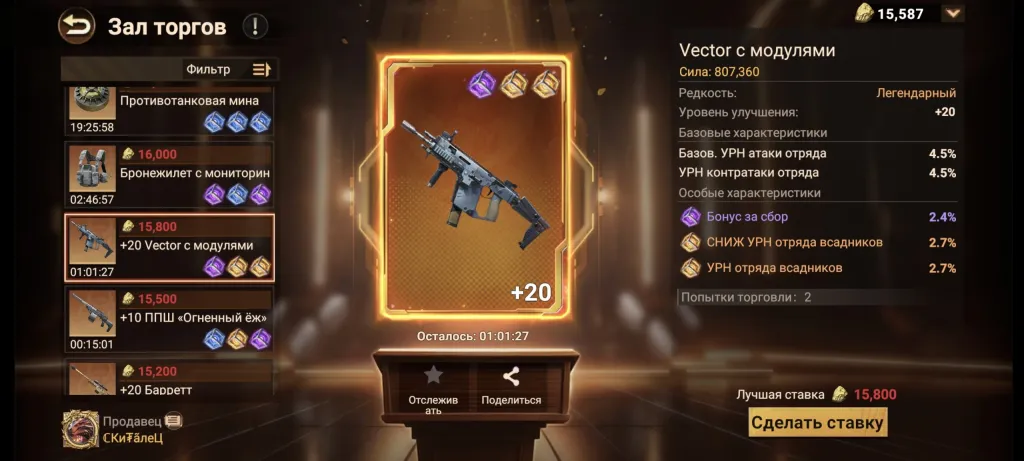
The screen below shows a different item: a +20 Vector with modules. Its special attributes include a 2.4% gathering bonus alongside two 2.7% Rider attributes: DMG and DMG Reduction. Assess that combination through the lines useful to your own task. A gathering bonus does not make the item useless for combat, but adds no combat value by itself.
This is an archived DoomsdayLS screen from August 2026. 15,800 was labeled the best bid at that moment; the final sale outcome is unknown. Use it to understand the item card rather than as today's price. Open the full-size screenshot.
How to compare your listing with others
Narrow the comparison first. Match the equipment slot, similar quality and upgrade level, then the relevant troop attributes and values. IGG's version history introduced attribute-range filters in version 1.58.0. They are more useful than browsing every gold card.
Read the combination. Two items sharing one strong attribute may differ substantially elsewhere. Write down which properties support your task. If one item suits a combat squad in several ways, comparing rarity alone hides that difference.
Separate an asking price from a completed trade. An expensive listing shows what the seller wants. It does not prove what buyers pay. Even a card disappearing from the list is not a reliable sale price without confirmation. Useful benchmarks require comparable items and, where available, confirmed auction results.
Why the Bidding Hall is a separate case
Ordinary offers and the Bidding Hall follow different buying processes. The Bidding Hall screen above shows a best bid, timer and participation button. Before comparing prices, establish that you are looking at the same sale method.
In version 1.60.0, dated 26 August 2026, IGG expanded eligibility: equipment with DMG Reduction ≥4.5% or DMG ≥4.5% could also enter the Bidding Hall. This was an entry condition, rather than a promise of strong demand. Do not substitute any other attribute merely because it has a similar percentage.
Before listing, open the chosen venue's rules and check eligible items, price bounds, possible deductions, duration and how proceeds are received. Before buying, check the total and delivery status. An old guide should not replace what the game shows before confirmation. If you plan to resell the purchase, check Trading Attempts remaining on two original item cards.
Keep, melt down or sell?
Keep an item if it improves the attributes you need in your active set. Compare it with what is already equipped: the find's rarity cannot answer that question for you.
Use it for upgrading or melting down only after checking the result and material cost. Review which attributes will change and which item will be consumed. Do not confirm just because the original item seems unnecessary.
List an item when you understand the possible buyer and have a benchmark among similar offers. Additional upgrades for a sale are a separate expense. First consider whether they make the item more attractive and whether there is evidence that revenue can recover the material cost.
If an item does not sell, return to three questions: who needs its attributes, what you compared the price with and what supports that benchmark. Sometimes the sensible result is to conserve materials and keep an already useful set. Forging again creates another chance at an item, but does not create its buyer.
Frequently asked questions
Can every rare item be sold for a high price?
Is the bid in the screenshot the current Vector price?
Sources
- IGG / Steam — Squad Equipment, Refinery and Auction House, version 1.49.0
- IGG / App Store — attribute filters and Bidding Hall eligibility, versions 1.58.0–1.60.0
- Reddit — one player's experience selling equipment for Gold
- Reddit — a rare item with attributes unsuited to the player's task
- DoomsdayLS — original Bidding Hall screen, 26 August 2026