
Pompeii under fog: an empty-looking map no longer means safety
War Fog, Tactical Orders and Apex for the top 120 alliances changed Recovery of Pompeii. Here is how to distinguish missing visibility from a missing enemy.
Published · Updated
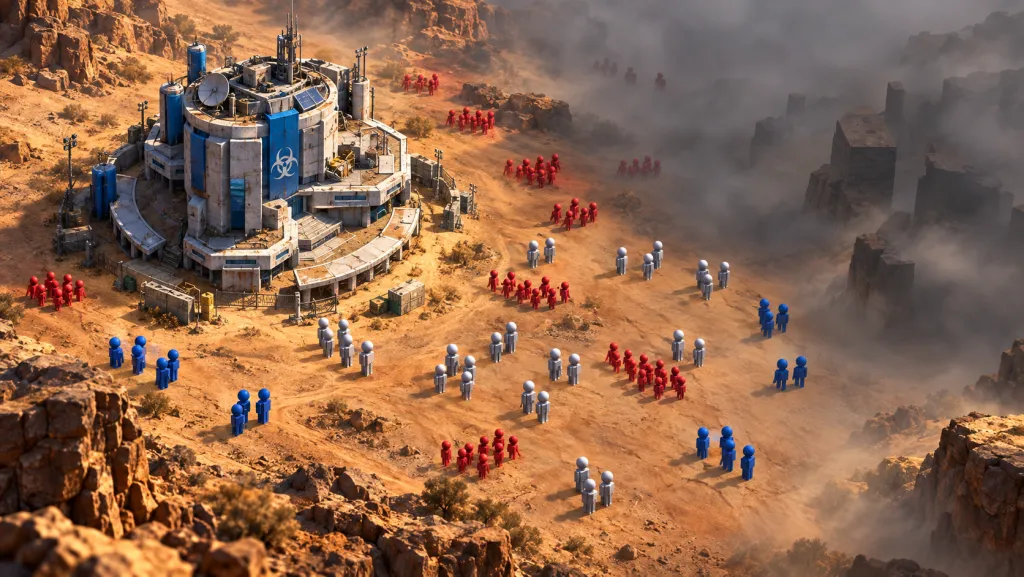
The screen looks empty. Is it safe to send squads forward? After the Pompeii update, that question needs more care: ‘I cannot see an enemy’ and ‘there is nobody there’ convey different information. War Fog increases the value of information, while the new Apex Battlefield raises some participant attributes. Here is what that means for a team.
This article concerns Recovery of Pompeii in Doomsday: Last Survivors following version 1.60.0, released on 26 August 2026. IGG added War Fog, Tactical Orders and a separate Apex Battlefield. Below are the update's confirmed conditions and our practical suggestions for preparing a team.
Apex: the top 120 does not mean identical accounts
Apex admits the top 120 registered alliances by Rating across all servers. The ranking is determined after registration closes. This selects alliances, rather than granting individual entry based on your account's Might.
Inside Apex, IGG maximizes Commander Equipment, Commander Parts, Vehicle Workshop and other Parts attributes. We retain the announcement's names: the list should not be extended to every aspect of account development.
An easy mistake is to conclude that, because equipment is boosted, everyone's heroes, Armament and other systems must also be equal. The update description makes no such promise. Before fighting, compare your chosen lineup's attributes inside the relevant battlefield, rather than building a plan around a vague idea of ‘balance’.
Fog changes what ‘empty’ means
At about 21:50 in Zeus's War Guide's recording, fog covers part of the map and the Tactical Orders button appears on the left. This is an original gameplay frame, with no redrawn interface. It shows conditions in one match, but does not by itself reveal vision ranges or detection rules.
A useful team principle follows: every enemy report needs a location and an observation time. ‘Nobody is at the building’ sounds like an invitation to attack. ‘I last checked the approach a minute ago; we have no vision now’ lets the commander verify the situation first.
Look at the center of the frame below: you cannot confidently count enemy squads from it. Nor should you invent a count from one minimap state. A link beside the frame opens the full-size image.
Open the full-size game frame.

Orders need a group ready to act
Tactical Orders is a separate battlefield system. Having the button does not answer three questions: who chooses the moment, which squads carry out the task and where they go afterwards. These arrangements can be agreed before the match starts.
We suggest this sequence: establish the objective and fresh information, confirm the necessary group is ready, then use the appropriate order. This is an editorial coordination recommendation, rather than an additional IGG rule.
For example, an officer announces an attack while part of the team is still busy elsewhere. Activating a boost on the strength of one chat message may waste it on waiting. A short ‘group ready’ confirmation is more useful than simultaneous calls to rush different buildings.
Check order names, costs and durations in the mode's current menu. Older Pompeii Glory League guides describe a different competitive format: their restrictions should not automatically be applied to the updated Pompeii mode.
One report instead of ten guesses
Before a match, try agreeing on a format: objective → what is visible → when it was checked → what is needed. For example: ‘North approach to the bio facility: two enemy squads visible, checked now, covering group needed.’ This is a teaching example, rather than a specific map plan or a required squad count.
If contact is lost, report that separately: ‘Vision lost; the earlier count is no longer confirmed.’ This stops an old observation from remaining an eternal fact in chat. The commander can then distinguish a known threat from an area where information is missing.
A common weakness becomes obvious: players are on the field, but nobody knows whose messages are orders. If this happens repeatedly, start by discussing responsibilities and gathering times. The article on choosing a Doomsday alliance includes an activity and communication check for an ordinary week of play.
What to review after the first battle
Instead of saying ‘they overwhelmed us’, choose one lost objective and reconstruct the sequence: what the team knew before the decision, who gave the order, whether the assigned players were ready and when reinforcements arrived. Note separately where information was simply unavailable.
One change is enough for the next match: assign someone to report from a route, confirm the group's lineup in advance or stop passing on unverified counts. Fog does not guarantee victory for a better-organized team. This review does help distinguish a lack of strength from a decision based on an outdated picture.