
100 Chimera materials do not guarantee a Chimera relic
Four slots of 25 materials pay for an attempt, not a chosen group. Where RAID shows separate probabilities for relic rarity and group.
Published · Updated
100 Chimera materials do not guarantee a relic from that group: the Forge still has a 50% chance of the Standard group. To interpret the result, first distinguish relic rarity, rank and level. Here we examine another property: its group and crafting materials.
Four slots pay for one attempt
Ocular Masses are relic crafting materials. You can obtain them from Chimera chests and by completing objectives in Chimera battles. They are not a finished item with a chosen ability: you must first use the materials in the Forge.
Open Relic Crafting and fill all four slots. Each attempt needs 25 materials per slot: 4 × 25 = 100. You can combine different material types and rarities, so this tab does not represent a single fixed recipe.
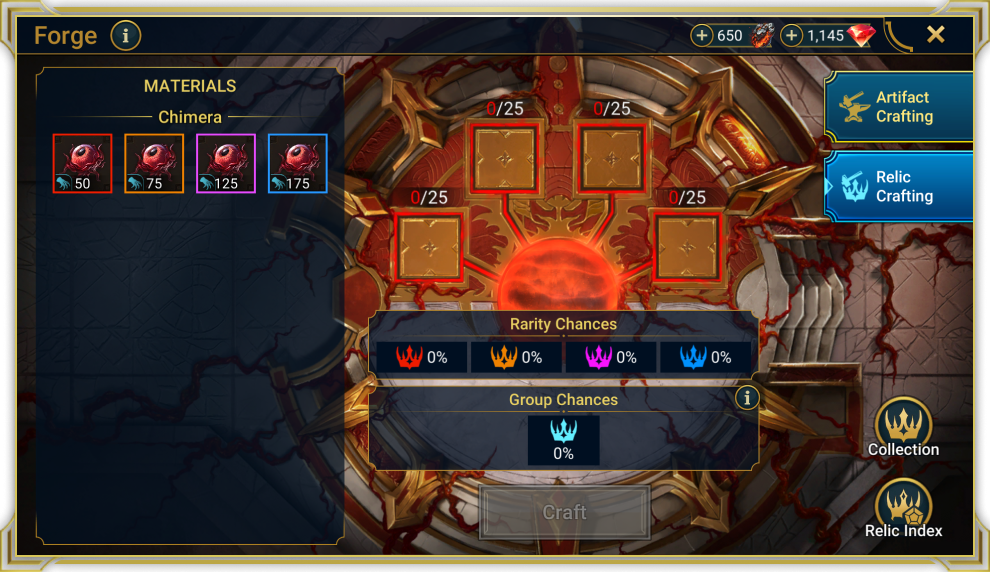
Open the original screen at full size.
Crafting a relic and ranking up an existing one are separate actions with different consumables. If a task requires crafting, levelling an old item will not count instead. Before choosing materials, note the exact requirement: obtain a new relic or develop one you already own.
Standard group does not mean low rarity
A type or group comprises a set of relics. The English window calls it Group, with examples such as Chimera and Standard. The Russian guide calls Standard relics ordinary. Here, ordinary means group membership, not another rarity tier below Rare. Do not mistake the result for an error because of a familiar word.
The Chimera group has its own material, while Standard is associated with all crafting materials. The official guide explicitly assigns a 50% chance to Standard. Filling all four slots with Ocular Masses therefore does not turn the remaining distribution into a 100% Chimera guarantee.
Rarity is a separate property. Higher-rarity materials improve the chance of a rarer relic; more materials of a particular type improve the chance of its group. Read these conditions together without substituting one for the other. Wanting a Mythical item and wanting Chimera specifically are two different checks.
Check both probability rows
Below the filled slots are Rarity Chances and Group Chances. In the demonstration below, the first row shows 2,82% Mythical, 20,05% Legendary, 27,68% Epic and 49,46% Rare. The second row separately shows 50% Chimera and 50% Standard.
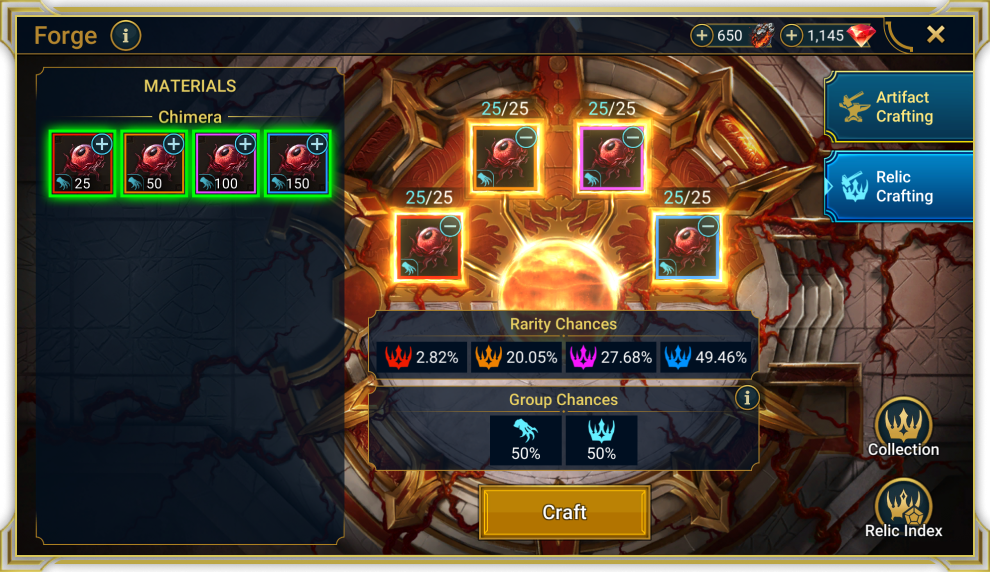
Open the original screen at full size.
After replacing a material, read both rows again: the guide says probabilities update when the combination changes. Do not apply the 2,82% from someone else’s screenshot to your materials. Use the Forge numbers shown after you fill the slots, not the colour of a single item in storage.
Select Info beside Group Chances to see each group’s relics. A group’s probability is not the probability of a chosen item in that list. Nor do the two distributions give the percentage for a specific Mythical relic: do not multiply them without a confirmed calculation rule.
50% does not mean exactly one Chimera relic in every two crafts, nor does it prescribe an order. Do not increase your budget because the previous result was Standard. The number describes a possible outcome, not a promise to compensate for it on the next attempt.
What to record before selecting Craft
- Your goal: any new relic, a particular group or a specific ability. These are different expectations.
- The materials in all four slots and the number of attempts you accept.
- Rarity and group chances after the last combination change.
- An acceptable outcome: are you willing to spend this stock if the desired group or item does not drop?
For example, 500 suitable materials can fill four slots of 25 for five attempts. This calculates the number of crafts, not five Chimera relics or a promise of one Mythical. If you want only one specific item, that stock alone does not prove you can reach the goal.
After obtaining a relic, check its ability and sockets before spending more. For Gemstones, see socket shape compatibility. A crafting decision ends with checking its result; choose the next step from the properties of the item you actually received.